
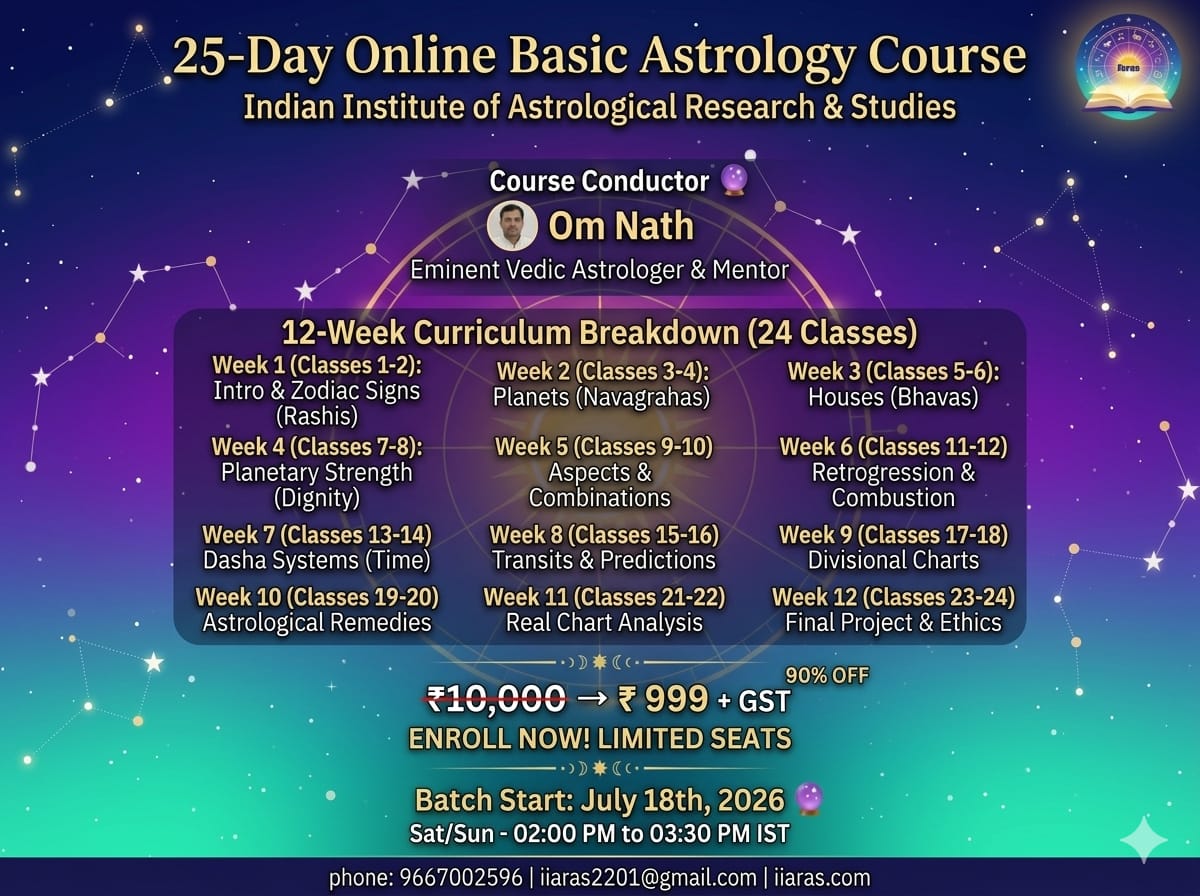
Here is a comprehensive, structured syllabus for a 3-month Basic Vedic Astrology course. Since it covers **24 classes over 12 weeks**, the curriculum is designed at a steady pace of **2 classes per week**, perfectly balancing fundamental theory with hands-on chart-reading practice.
# Course Overview
* **Duration:** 3 Months (12 Weeks)
* **Total Lectures:** 24 Classes (2 classes per week, 90 minutes each)
* **Objective:** To take a student from absolute zero to confidently analyzing a North/South Indian birth chart, understanding planetary strengths, and predicting basic life trends.
## Month 1: Foundations of the Cosmic Script (Classes 1–8)
The first month focuses entirely on building the foundational vocabulary of astrology. Students will learn to see a birth chart not as a confusing grid, but as a map of time and space.
1. Class 1: Introduction & The Astronomical Base
Week 1, Class 1
Origin and philosophy of Vedic Astrology (Jyotish).
Understanding the Zodiac belt (360°) and the concept of the Ayanamsa.
Difference between Astronomy and Astrology.
Introduction to the two main chart formats: North Indian vs. South Indian style.
2. Class 2: The 12 Rashis (Zodiac Signs) - Part 1
Week 1, Class 2
Deep dive into Signs 1 to 6 (Aries to Virgo).
Core attributes: Elements (Fire, Earth, Air, Water) and Modalities (Movable, Fixed, Dual).
Sign lordships and natural significations (Karakatwas).
3. Class 3: The 12 Rashis (Zodiac Signs) - Part 2
Week 2, Class 1
Deep dive into Signs 7 to 12 (Libra to Pisces).
Understanding the anatomy of the Zodiac (Kala Purusha Kundali).
How signs shape psychological traits and physical environments.
4. Class 4: The Nine Planets (Navagrahas) - The Cosmic Actors
Week 2, Class 2
Detailed study of the Sun, Moon, Mars, and Mercury.
Planetary temperaments (Sattva, Rajas, Tamas) and gender.
Natural significations: Who represents the soul, mind, siblings, and intellect?
5. Class 5: The Navagrahas Continued
Week 3, Class 1
Detailed study of Jupiter, Venus, Saturn, and the shadow planets (Rahu & Ketu).
Understanding the karmic roles of the outer planets (Saturn/Rahu/Ketu).
6. Class 6: Planetary Relationships (Sambandha)
Week 3, Class 2
Natural friendship, enmity, and neutrality (Naisargika Mitra/Satru).
Temporal or situational relationships (Tatkalika Mitra).
Calculating the compound relationship (Pancha-Dha Maitri).
7. Class 7: The 12 Bhavas (Houses) - Houses 1 to 6
Week 4, Class 1
The concept of Houses as fields of life experience.
Detailed study of Houses 1 through 6: Self, Wealth, Courage, Home, Intellect, and Obstacles.
Classification: Kendra (Angular) and Trikona (Trinal) houses.
8. Class 8: The 12 Bhavas - Houses 7 to 12
Week 4, Class 2
Detailed study of Houses 7 through 12: Partnerships, Longevity, Fortune, Career, Gains, and Losses.
Classification: Dussthanas (Evil houses), Upachayas (Growth houses), and Trishadaya.
## Month 2: Planetary Strengths & Configurations (Classes 9–16)
Month two transitions from definitions to dynamics. Students learn how planets behave based on where they sit and who they hang out with.
1. Class 9: Planetary Dignities (Exaltation & Debilitation)
Week 5, Class 1
Concept of Uchha (Exaltation) and Neecha (Debilitation) with exact degrees.
Moolatrikona and Own Sign (Swarashi) dynamics.
Introduction to the concept of Neechabhanga (Cancellation of Debilitation).
2. Class 10: Planetary Aspects (Drishti)
Week 5, Class 2
The rules of cosmic sight: Direct 7th house aspects for all planets.
Special aspects of outer planets: Mars (4th, 8th), Jupiter (5th, 9th), and Saturn (3rd, 10th).
Practical exercises mapping aspects on a blank chart grid.
3. Class 11: Combustion, Retrogression, and Planetary War
Week 6, Class 1
Combustion (Asta): What happens when a planet gets too close to the Sun.
Retrogression (Vakra): Psychological shifts and karmic weights of retrograde planets.
Planetary War (Graha Yuddha): Rules and resolution.
4. Class 12: Understanding the Ascendant (Lagna)
Week 6, Class 2
What is the Lagna and why does it change every 2 hours?
The difference between the Lagna (Physical Self), Moon Sign (Emotional Self), and Sun Sign (Soul Expression).
The concept of Bhavat Bhavam (House to House reflection).
5. Class 13: Fundamentals of Nakshatras
Week 7, Class 1
Moving beyond signs: Introduction to the 27 Lunar Mansions (Nakshatras).
The 4 Padas (quarters) of a Nakshatra and their elemental mapping.
Core nakshatras governing the start of the zodiac (Aswini, Bharani, Krittika).
6. Class 14: Major Vedic Yogas - Part 1
Week 7, Class 2
Definition of a "Yoga" (Planetary Combination).
Pancha Mahapurusha Yogas (Ruchaka, Bhadra, Hamsa, Malavya, Sasa).
Solar and Lunar Yogas (Sunaphi, Anapha, Durudhara, Kemadruma).
7. Class 15: Major Vedic Yogas - Part 2
Week 8, Class 1
Raja Yogas and Dhana Yogas (Combinations for status and wealth).
Crucial functional negative combinations: Parivartana (Exchange) and basic Aristha Yogas.
8. Class 16: Mid-Course Practical Synthesis
Week 8, Class 2
Live case study session.
Step-by-step assembly: Combining Sign + House + Planet + Aspect to form a coherent observation.
## Month 3: Timing Events & Practical Chart Analysis (Classes 17–24)
The final month brings the chart to life by introducing the dimension of time, allowing students to map out *when* potential promises in a chart will manifest.
1. Class 17: Vimshottari Dasha System - The Map of Time
Week 9, Class 1
Mechanics of the 120-year cycle Vimshottari Dasha.
How to calculate the starting Dasha based on the Moon's Nakshatra.
Concepts of Mahadasha (Major period) and Antardasha (Sub-period).
2. Class 18: Interpreting Dasha Effects
Week 9, Class 2
Rules for evaluating a Dasha lord: Functional lordship, placement, and strength.
Predicting life shifts during major Dasha transitions (Chidra Dasha).
3. Class 19: Transits (Gochara) - The Current Sky
Week 10, Class 1
How transiting planets interact with the natal chart.
The significance of transits from the Moon Sign (Chandra Lagna).
Tracking slow-moving planets: Jupiter and Saturn transits.
4. Class 20: Sade Sati and Dhayya
Week 10, Class 2
Demystifying Saturn’s 7.5-year transit cycle (Sade Sati).
Calculation, phases, and actual real-world psychological effects.
Remedial concepts and myths vs. reality.
5. Class 21: Introduction to Divisional Charts (Vargas)
Week 11, Class 1
Why the main chart (D1) isn't enough.
Introduction to the Navamsa (D9) chart—the chart of inner potential and partnerships.
How to cross-verify planet strengths between D1 and D9 (Vargottama).
6. Class 22: Basic Predictive Framework
Week 11, Class 2
Establishing a fixed 5-step reading protocol for any chart to avoid confusion.
Analyzing specific life areas: Health/Personality (1st house) and Education/Career foundation (4th/5th/10th).
7. Class 23: Practical Chart Drills & Live Readings
Week 12, Class 1
Students bring blind charts to class.
Interactive group analysis focusing on isolating strengths, weaknesses, and current running periods.
8. Class 24: Remedial Measures, Ethics & Course Wrap-up
Week 12, Class 2
The philosophy of remedies (Mantra, Charity, Lifestyle alterations).
Ethical boundaries of an astrologer: